STAKEHOLDER INTERVIEW GUIDE
Manager Capability Programme
Purpose: Understand the business context, current management capability, employee experience and barriers to effective people management.
Project stage: 1.1 — Understand
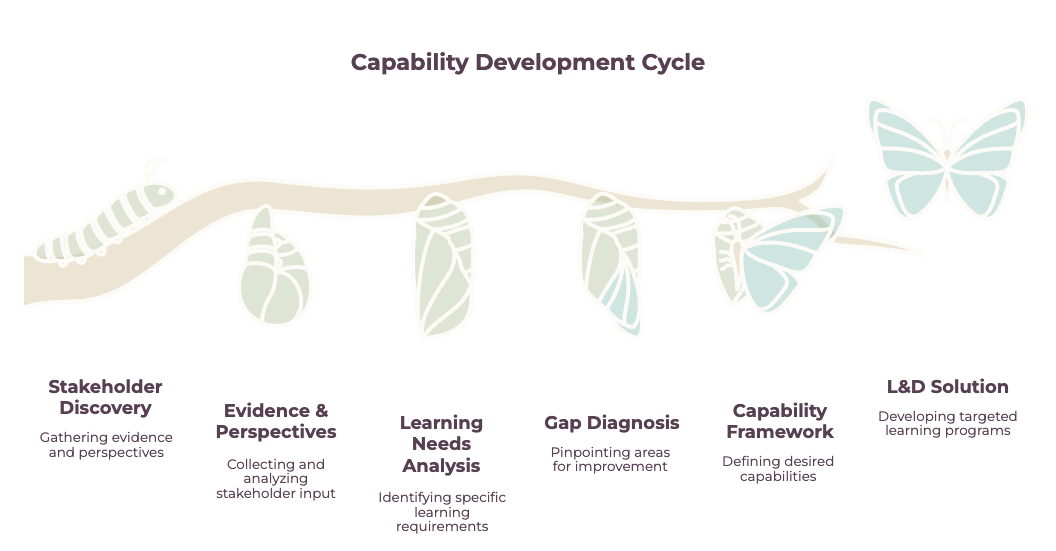
L&D process: Capability Development Cycle
Status: Hypothetical portfolio example
1. PURPOSE OF THE INTERVIEWS
The purpose of stakeholder interviews is to build a shared understanding of the management capability challenge before defining the learning solution.
The interviews explore:
the business need
current management behaviours
employee experience
capability gaps
barriers to application
existing organisational support
desired future behaviours
The information gathered would contribute to the Learning Needs Analysis and subsequent Capability Framework.
Principle: A request for "manager training" is a starting point for investigation, not a diagnosis.
2. STAKEHOLDER GROUPS
The discovery process would involve five stakeholder groups.
Senior Leaders
Strategic and business perspective
Business priorities, expectations and performance challengesHR Business Partners
People and organisational perspective
Recurring management issues, patterns and existing interventionsManagers
Practitioner perspective
Current capability, challenges, confidence and barriersEmployees
Learner/customer perspective
Experience of management and desired behavioursPeople Analytics / HR
Evidence perspective
Relevant people and performance data
The questions would be adapted to each stakeholder group rather than using one generic interview script.
3. SENIOR LEADER INTERVIEW
Objective
Understand why manager capability matters to the organisation and what successful management should look like from a business perspective.
Business context
What are the main business priorities currently affecting your teams?
Where does management capability have the greatest impact on those priorities?
What management challenges are currently affecting performance?
What would you most like managers to do differently?
Expectations
What does effective people management look like in this organisation?
What behaviours distinguish your strongest managers?
Where is there currently inconsistency between managers or teams?
What leadership behaviours will become increasingly important in the future?
Performance
Where are you seeing the greatest performance challenges?
Are there recurring issues that you believe stronger management capability could influence?
What would improve if managers became more effective?
Success
If this programme were successful six months from now, what would you expect to see differently?
What evidence would convince you that the programme had made a difference?
Which organisational outcomes would matter most?
Closing question
If you could change one management behaviour across the organisation, what would it be?
4. HR BUSINESS PARTNER INTERVIEW
Objective
Understand recurring people-management issues, organisational context and existing HR interventions.
Current challenges
What management issues do you see most frequently?
Which issues are repeated across teams?
Where do managers appear least confident?
What types of situations are most frequently escalated to HR?
Performance management
How effectively are managers currently addressing performance issues?
Are issues typically addressed early or after they have escalated?
What patterns do you see in performance-management cases?
People development
How consistently are managers supporting employee development?
Are development and career conversations happening regularly?
What barriers prevent managers from developing their people?
Organisational context
What existing management processes, tools or learning resources are available?
What has already been tried?
What has worked?
What has not worked?
Are there organisational processes or expectations that managers currently find difficult to navigate?
Partnership
What would you need from L&D for this programme to be successful?
How could HRBPs reinforce the capability after the learning intervention?
Closing question
What do you think is the biggest gap between what managers are expected to do and what they currently do?
5. MANAGER INTERVIEW
Objective
Understand managers' lived experience of leading people, including capability, confidence and barriers to application.
Current role
What are the most challenging parts of your role as a manager?
Which people-management responsibilities take the most time?
Which management situations do you feel most confident handling?
Feedback
How comfortable are you giving constructive feedback?
What makes feedback conversations difficult?
How often do you give feedback outside formal performance processes?
What tends to happen when an employee reacts negatively to feedback?
Coaching and development
How do you currently support employee development?
How comfortable are you having career or development conversations?
When an employee comes to you with a problem, how do you typically respond?
Performance
How confident are you addressing underperformance?
What makes difficult performance conversations challenging?
How early do you typically address performance concerns?
Accountability
How do you set expectations with your team?
How do you follow up on agreed actions?
What makes it difficult to maintain accountability?
Barriers
What prevents you from managing people as effectively as you would like?
Are there processes, systems or organisational expectations that make management more difficult?
What support would make the biggest difference?
Learning preferences
What type of development would be most useful to you?
What opportunities do you currently have to practise management skills?
What would make a management programme genuinely useful rather than something you simply have to attend?
Closing question
What is one people-management situation you would most like to feel more confident handling?
6. EMPLOYEE INTERVIEW
Objective
Understand management capability from the employee perspective and identify the behaviours that most influence employee experience and performance.
Management experience
What does good management look like from your perspective?
What do you value most from your manager?
How clear are you about what is expected of you?
How consistent is your management experience?
Feedback
How often do you receive useful feedback?
What makes feedback from a manager helpful?
Do you receive feedback early enough to act on it?
Development
How well does your manager support your development?
How often do you discuss your development or career?
Do you feel your manager understands your strengths and development needs?
Performance and accountability
How clearly does your manager communicate expectations?
How effectively are performance issues addressed?
Do managers follow through on commitments and agreed actions?
Relationship and support
How comfortable do you feel raising challenges with your manager?
Do you feel listened to when you raise concerns?
What could your manager do differently to support your performance?
Closing question
If your manager changed one behaviour that would make the biggest difference to your experience at work, what would it be?
7. PEOPLE ANALYTICS / HR DATA DISCOVERY
Objective
Identify quantitative evidence that can complement stakeholder perspectives.
This is not a traditional interview but a structured data-discovery conversation with the relevant HR or People Analytics stakeholder.
Data availability
What people and performance data is currently available?
Which indicators are already tracked at manager, team or organisational level?
What historical data is available for comparison?
Potential indicators
Explore the availability and relevance of:
employee engagement
manager effectiveness
retention
regretted attrition
internal progression
absence
employee relations cases
performance-management activity
development-plan completion
employee survey results
1:1 or development conversation indicators
Data quality
How reliable and consistent is the available data?
Can data be segmented by team, manager population or business area?
Are there known limitations or contextual factors?
Evaluation
Which indicators could provide a meaningful baseline?
Which indicators could be revisited after the intervention?
What would constitute meaningful movement?
Closing question
Which available data would give us the strongest evidence about the current state of management capability?
8. CROSS-STAKEHOLDER QUESTIONS
Some questions should be deliberately repeated across stakeholder groups.
This allows L&D to identify areas of alignment and discrepancy.
Example
Senior leader:
"Managers need to address performance issues earlier."
Manager:
"I want to address issues earlier, but I'm not always clear about the process."
Employee:
"Performance issues often seem to be addressed only after they have become serious."
This creates a more useful diagnosis than relying on any one perspective.
9. DISCOVERY THEMES
Interview findings would be organised around five themes.
01 — Business need
What organisational outcomes are affected?
02 — Current behaviour
What are managers doing today?
03 — Desired behaviour
What should managers do differently?
04 — Capability gap
What knowledge, skills or confidence are missing?
05 — Environmental barriers
What organisational conditions prevent application?
These themes provide the bridge into the Learning Needs Analysis.
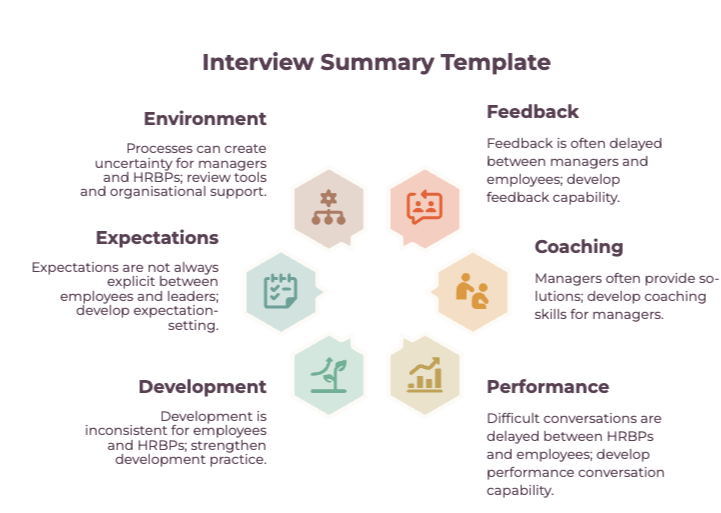
10. INTERVIEW SUMMARY TEMPLATE
Following the discovery conversations, findings would be consolidated rather than reported as isolated interview notes.
Feedback
Feedback is often delayed
Managers + employees
Develop feedback capability
Coaching
Managers often provide solutions
Managers
Develop coaching skills
Performance
Difficult conversations are delayed
HRBPs + employees
Develop performance conversation capability
Development
Development is inconsistent
Employees + HRBPs
Strengthen development practice
Expectations
Expectations are not always explicit
Employees + leaders
Develop expectation-setting
Environment
Processes can create uncertainty
Managers + HRBPs
Review tools and organisational support
11. FROM DISCOVERY TO DIAGNOSIS
The stakeholder discovery process feeds directly into the next stage of the Capability Development Cycle.
The purpose of the interviews is therefore not simply to collect opinions.
It is to generate enough evidence to make a reasoned L&D diagnosis.
12. L&D PRINCIPLE
Start with the problem, not the programme.
Effective L&D partnership requires understanding the business context, listening to different stakeholders and identifying the actual capability gap before deciding what learning intervention is appropriate.
A request for training may ultimately result in:
learning
practice
coaching
tools
process changes
leadership reinforcement
…or a combination of interventions.
The role of L&D is to determine what will best enable the required capability and performance, rather than automatically turning every problem into a course.