Learning Needs Analysis
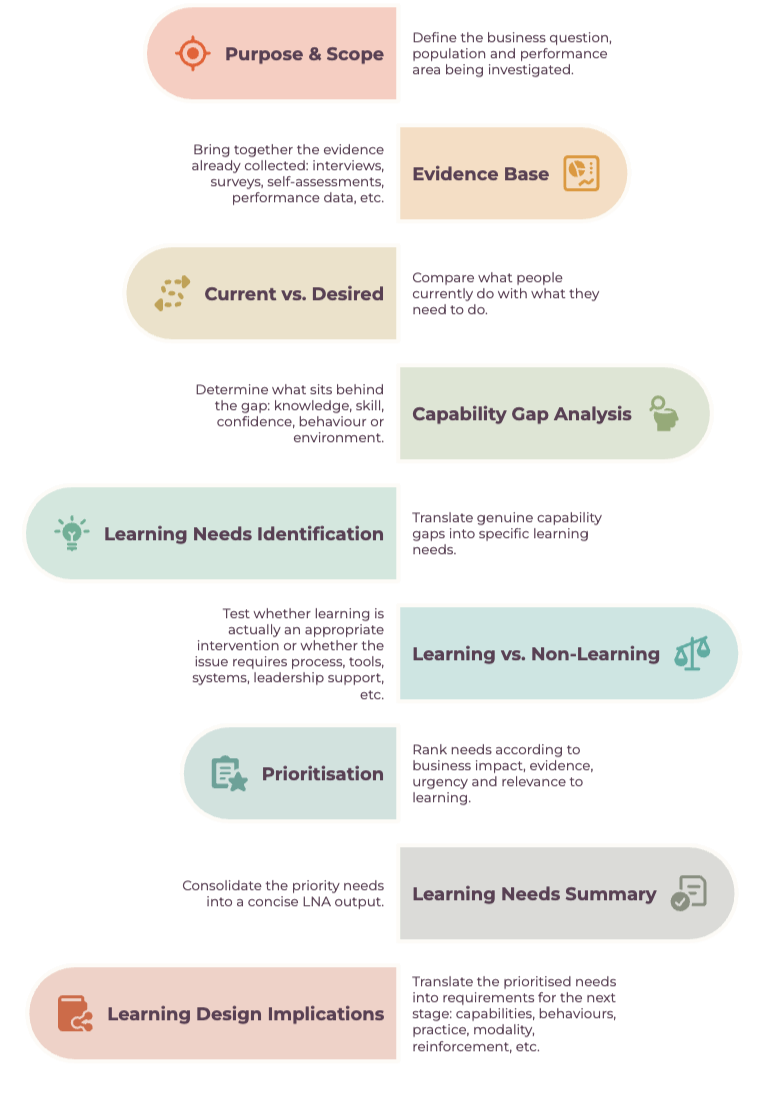
LNA Process Sections
Purpose & Scope
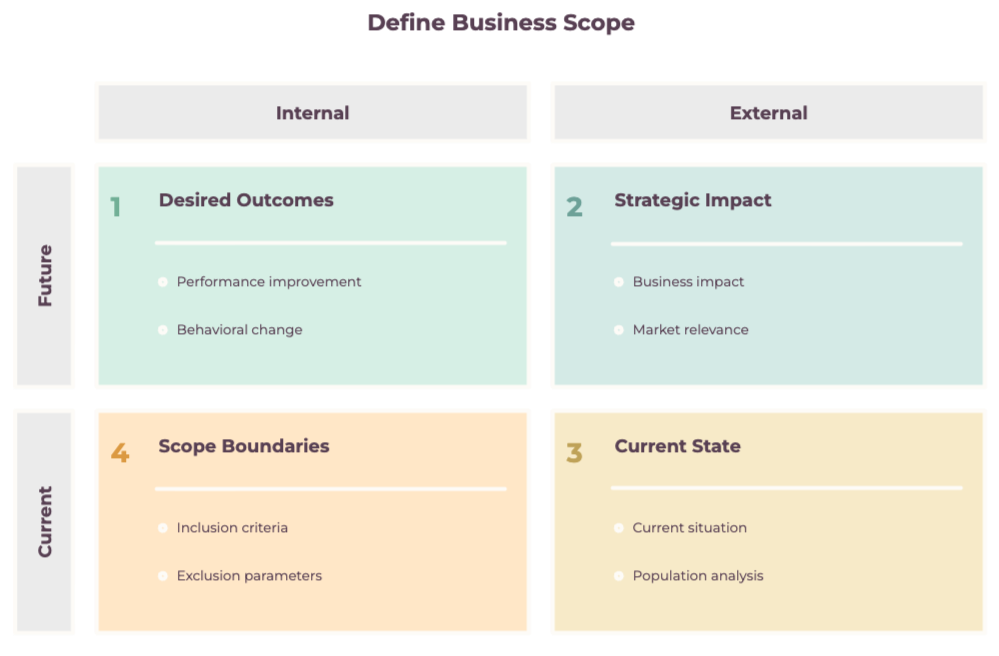
A. Business question
Start with the business problem. Ask: What business or performance outcome are we trying to improve?
Then define:
Current situation: What is happening now?
Business impact: Why does it matter?
Desired outcome: What would better performance look like?
Example:
Business question: What is preventing managers from consistently addressing performance issues early, and what support would enable them to do so effectively?
B. Population
Define who is actually being investigated and specify:
Who performs the behaviour?
Which roles / teams / levels?
Approximate population size, if known
Are you investigating everyone or a sample?
Example:
Population: People managers across the organisation, with particular attention to first-line managers and recently appointed managers.
C. Performance area
Define the specific behaviour or performance that is being investigated. Ask: What are people expected to do, and what are they currently doing?
For example:
Performance area: Managing employee expected behaviour:
Set clear expectations
Give timely feedback
Address underperformance early
Agree actions and follow up
D. Practical Template
2. Evidence-Based
The resource should tell you exactly how to organise the evidence, without repeating the stakeholder interview guide
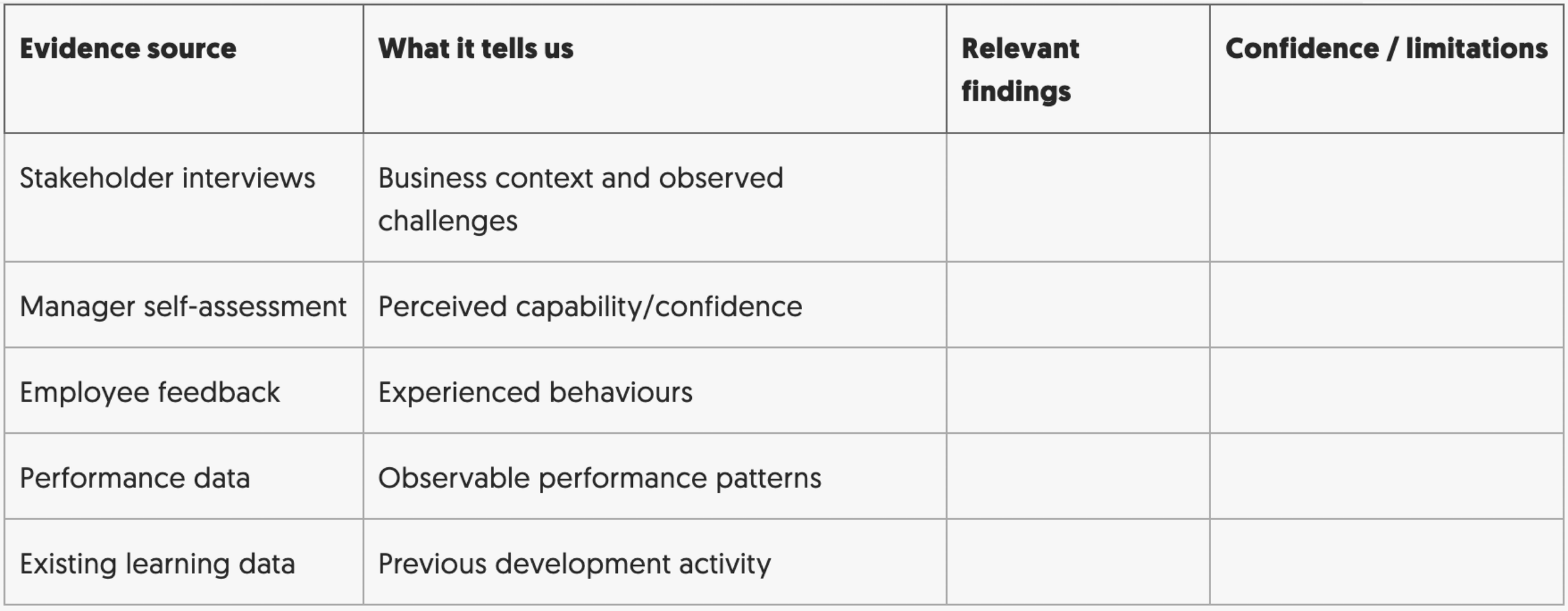
The purpose is to bring all relevant evidence into one place before interpreting it.
For each source, record:
What does this evidence measure?
What question does the source help answer?What does it tell us?
Record the relevant findings — not every piece of information collected.What limitations does it have?
For example, self-report bias, small sample, incomplete data or lack of baseline.What does it add to the overall picture?
Identify whether it confirms, challenges or adds context to other evidence.
Output
The result is one consolidated evidence base that you can use in the next step:
Evidence → Analysis → Gap diagnosis
The important point is that you don't diagnose the problem yet. At this stage, you're organising and assessing the quality/relevance of the evidence so that the diagnosis is based on more than one source.
3. Current vs Desired
The purpose is to define what is happening now and compare it with what effective performance should look like.
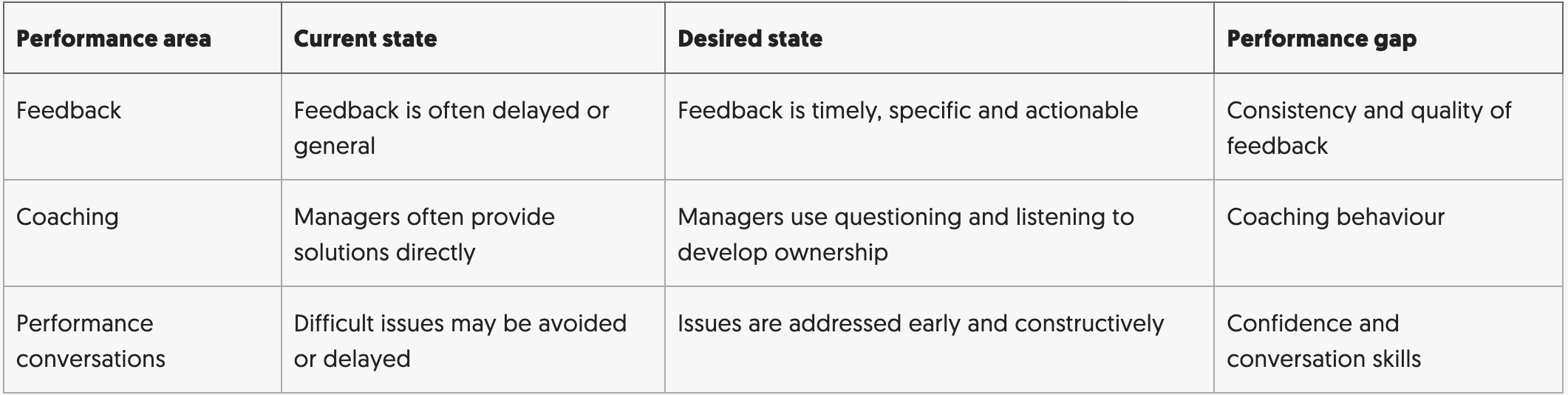
Use a simple current → desired → gap table:
How to apply it
For each performance area:
1. Current state — What is happening now?
2. Desired state — What should be happening?
3. Performance gap — What is the difference between the two?
Example: Current: Conversations are delayed. VS Desired: Conversations happen early.
→Gap: Managers need greater ability and confidence to address difficult conversations.
Output
A set of clearly defined performance gaps that can then be diagnosed in the next section:
Current behaviour → Desired behaviour → Performance gap → Why does the gap exist?
That last question is important because the performance gap is not automatically a learning need.
4. Capability Gap Analysis
Determine why the performance gap exists and what is preventing effective performance.
For each gap, assess whether it relates to:
Knowledge — Does the person know what to do?
Skill — Can they do it effectively?
Confidence — Do they feel able to apply it?
Behaviour — Are they consistently applying it?
Environment — Are processes, tools or organisational conditions preventing application?
Example:
Performance gap: Difficult conversations are delayed.
Diagnosis: Skill + confidence, with a potential process/environment factor to investigate.
Output: A diagnosed capability gap that distinguishes what learning can address from what requires another intervention.
5. Learning Needs Identification
Translate the diagnosed capability gaps into specific learning needs.
For each gap, define:
What needs to be learned or developed?
Who needs it?
What should they be able to do afterwards?
Example:
Capability gap: Managers lack confidence and skill in difficult conversations.
Learning need: Develop the skills and confidence to prepare for and conduct difficult conversations effectively.
Output: A clear set of defined learning needs that can be prioritised and translated into learning objectives.
6. Learning vs. Non-Learning Needs
Determine whether each identified gap is actually addressable through learning.
Ask:
Is it a knowledge or skill gap?
Is confidence or practice the issue?
Is something outside the learner preventing performance?
Would process, tools, systems or leadership support be more appropriate?
Output: The appropriate intervention type.
7. Prioritisation
Rank the identified needs according to:
Business impact
Evidence strength
Urgency
Learning relevance
Output: A prioritised list of learning needs.
8. Learning Needs Summary
Bring the analysis together into a concise summary of the priority learning needs and the evidence behind them.
Output: Clear LNA conclusions.
9. Implications for Learning Design
Translate the priority learning needs into requirements for the next stage.
Consider:
Capabilities to develop
Behaviours to practise
Level of practice required
Appropriate learning methods
Reinforcement and support
Output: Clear design requirements for the learning solution.
10. Closing
Fulfilling 1.1.2 Learning Needs Analysis
This complete Learning Needs Analysis (LNA) fulfils (as an example) Section 1.1.2 — Learning Needs Analysis, from the Manager Capability Programme by translating the evidence gathered during discovery into diagnosed, prioritised learning needs and clear requirements for the next stage.
It provides the bridge between understanding the need and defining the capabilities and behaviours required.
Evidence → Gap → Learning Need → Priority → Design Requirements